 Simplifying your business.

 One software for all of your locations.

 Earn cash by referring businesses to us.



When someone searches for your services today, they might not even click on your website to find their answer. Instead, Google displays a featured snippet at the top of search results. Or they might ask ChatGPT or another AI tool, which generates an instant response by synthesizing information from across the web. If your content isn’t optimized for these AI-powered search results, you’re invisible in the moments that matter most.
Featured snippets and AI answers represent a fundamental shift in how customers discover businesses online. These coveted “position zero” results appear above traditional organic listings, capturing attention, and establishing credibility before users ever scroll down the page. For small businesses, earning a featured snippet means increased visibility, more qualified traffic, and the authority that comes with being the source Google trusts to answer important questions.
The good news? Optimizing for featured snippets doesn’t require technical wizardry or a complete website overhaul. It’s about understanding how AI systems read and extract information, then structuring your content to make their job easier.
Understanding Featured Snippets and AI-Powered Search Results
Featured snippets are the boxed answers that appear at the top of Google search results, designed to give users immediate information without requiring them to click through to a website. You’ve seen them countless times: a paragraph explaining “what is SEO,” a bulleted list of “best practices for email marketing,” or a table comparing different service options. Google pulls this content directly from a web page it determines best answers the searcher’s question, displaying it prominently above all other organic results, which is why featured snippets are often called “position zero.”
There are several types of featured snippets, each serving different search intents:
- Paragraph snippets: Provide concise definitions or explanations, typically 40-60 words long.
- List snippets: Break down steps, tips, or ranked items in bullet points or numbered formats.
- Table snippets: Organize comparative information like pricing, features, or specifications in an easy-to-scan grid.
Understanding these formats helps you structure your content to match what search engines are looking for. But featured snippets are just one piece of a larger transformation happening in search.
AI-powered search results, from Google’s Search Generative Experience (SGE) to ChatGPT, Bing Chat, and other AI assistants, are changing how people find information online. These tools don’t just display a link and a snippet; they synthesize answers from multiple sources, present them conversationally, and often cite their sources. When someone asks an AI assistant, “What’s the best way to winterize a small business storefront,” the AI scans the web for structured, authoritative content and generates a comprehensive answer on the spot.
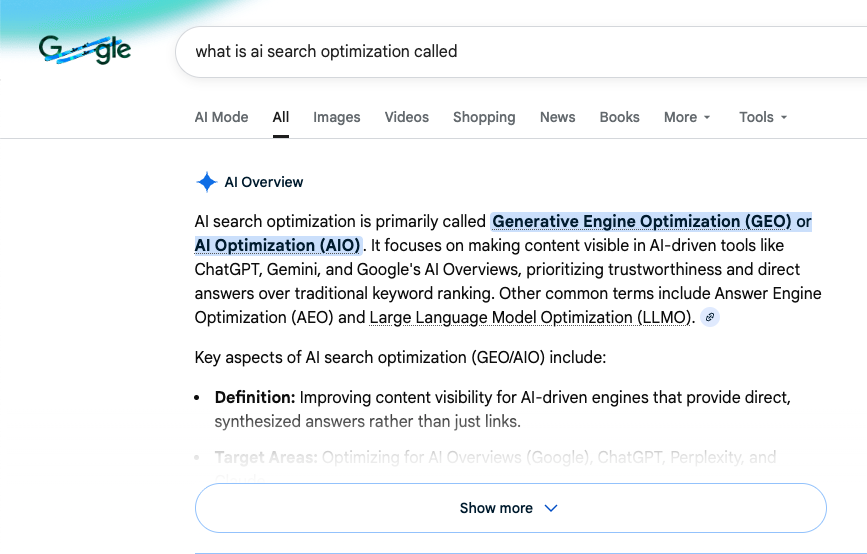
The key difference between traditional SEO and AI search optimization lies in how your content is structured and written. Traditional SEO focused heavily on keywords, backlinks, and page authority. While those factors still matter, AI systems prioritize clarity, directness, and logical organization. They need to extract meaning quickly and confidently. A page stuffed with keywords but lacking clear answers won’t make the cut, while structured content for SEO that directly addresses customer questions becomes a prime source for both featured snippets and AI-generated responses.
The stakes are significant. On average, featured snippets receive 35% of total clicks. As AI-powered search continues to grow, being recognized as a trusted source becomes even more valuable, not just for visibility today, but for building long-term authority in your industry.
Feature Snippet Optimization Tips
1. Write for answers, not marketing.
2. Structure your content for maximum visibility.
3. Keep your content fresh and relevant.
4. Target question-based keywords your customers are actually asking.
5. Create dedicated FAQ sections that directly answer common queries.
1. Write for answers, not marketing.
Key principle: Featured snippets favor direct answers, not marketing language.
Search engines and AI systems are designed to satisfy user intent as quickly as possible. When someone searches “how to remove coffee stains from carpet,” they want a solution, not a sales pitch about your cleaning services. Featured snippets reward pages that provide clear, concise answers in 40-60 words using simple, straightforward language.
The shift from marketing copy to answer-focused content can feel counterintuitive. You’re used to highlighting what makes your business unique, building brand voice, and persuading customers to choose you. But in the context of featured snippets, that approach works against you. AI systems scan for factual information they can extract and present confidently. Promotional language, vague claims, and fluffy introductions get filtered out.
To do this, start by identifying the questions your customers actually ask:
- Look at your customer service emails.
- Review the “People also ask” boxes in Google search results.
- Use tools like AnswerThePublic or Google’s autocomplete suggestions.
Then, answer those questions directly at the top of relevant pages or blog posts. For example, instead of writing “At ABC Plumbing, we pride ourselves on delivering exceptional drain cleaning services using state-of-the-art equipment,” write “Drain cleaning typically takes 1-2 hours and costs $150-300 depending on the severity of the clog and accessibility of your pipes.”
You can still include your marketing message, but put it after the direct answer. Lead with the information users need, establish yourself as a helpful authority, and then explain why your business is the right choice to solve their problem. This structure satisfies both search engines looking for snippet-worthy content and potential customers looking for reasons to trust you.
2. Structure your content for maximum visibility.
Key principle: Page structure matters as much as content quality.
AI systems don’t read web pages the way humans do. They scan for patterns, hierarchy, and logical organization that signal where important information lives. A wall of text is difficult for algorithms to parse and extract. But a page with clear headings, bullet points, tables, and formatted lists practically hands the AI exactly what it needs to create a featured snippet.
Start with your heading structure.
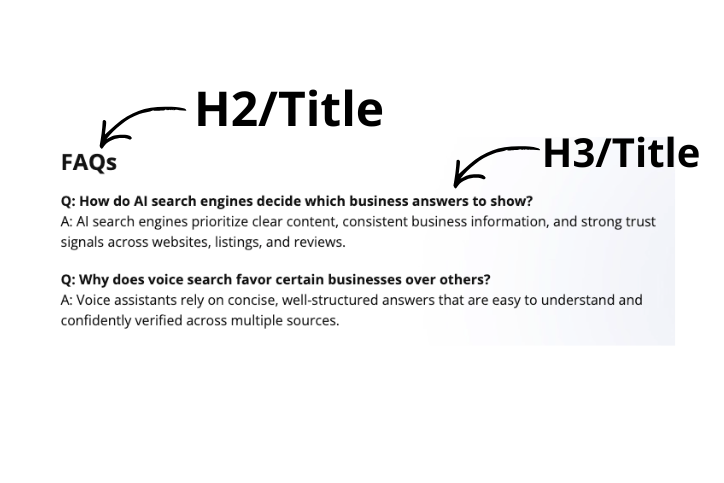
Use H2 tags to frame questions or main topics, and H3 tags for supporting subtopics. For example, an H2 might read “What Are the Signs You Need Furnace Repair?” followed by H3s like “Strange Noises,” “Inconsistent Heating,” and “Rising Energy Bills.” This hierarchy tells search engines how your content is organized, making it easy to extract specific sections.
Bullet points and numbered lists are featured snippet gold.
When you’re explaining steps, listing benefits, or outlining options, format them as lists rather than burying them in paragraphs. Search engines love lists because they’re scannable, straightforward, and easy to display in snippet format. A recipe with numbered steps, a checklist for seasonal maintenance, or a comparison of service tiers all perform well in list-based snippets.
Tables work exceptionally well for comparative information.
If you offer different service packages, pricing tiers, or product specifications, organize that data in a simple HTML table. Search engines can extract and display tables directly in search results, and users find them incredibly helpful for making quick decisions. Even a basic two-column table comparing “DIY vs. Professional” or “Basic vs. Premium” can earn snippet visibility.
3. Keep your content fresh and relevant.
Key principle: Regular content updates improve answer visibility over time.
Search engines prioritize recent, accurate information, especially for topics where details change frequently. If your service pages, blog posts, or FAQs contain outdated pricing, old product information, or references to “current” events from two years ago, search engines will question whether your content is still reliable. Fresh content signals relevance, and relevance keeps you eligible for featured snippets and AI-generated answers.
However, not all content needs constant updates, while certain types of pages benefit from regular review.
Types of content to review:
- Service descriptions should reflect any changes to what you offer, how you deliver it, or what it costs.
- Seasonal content, like “preparing your HVAC system for winter,” should be refreshed each year with current tips and trends.
- How-to guides should be reviewed whenever industry best practices evolve or new tools become available.
- Evergreen content benefits from occasional updates that add new examples, refine explanations, or expand on points based on customer feedback.
Create a simple content review schedule. Mark high-traffic pages for quarterly review, seasonal content for annual updates, and evergreen resources for twice-yearly check-ins.
During each review, ask:
- Is this information still accurate?
- Are there new customer questions we should address?
- Can we add recent examples or case studies?
Small, consistent improvements compound over time and signal to search engines that your site is actively maintained and trustworthy.
The benefit extends beyond featured snippets. Pages that receive regular updates often see improved rankings across the board, and fresh content gives you opportunities to target new keywords as customer language and search behavior evolve. Think of content updates as ongoing maintenance—not a one-time project, but a rhythm that keeps your website competitive and visible as search technology continues to advance.
Market and Grow Your Business More Effectively With Marketing Center
Marketing Center helps you attract new customers to your business and shows you which marketing strategies work best for your customers so you don’t waste time and money on the wrong tactics.
4. Target question-based keywords your customers are actually asking.
Key principle: Featured snippets are triggered by questions — optimize for how people search.
Most featured snippets appear in response to question-based queries: “how to,” “what is,” “why does,” “when should,” and “where can I find.” If you want to capture snippets, identify the specific questions your customers ask and build content around those queries. This means going beyond traditional keyword research and thinking like someone who’s searching for help, information, or solutions.
Start by listening to your customers.
What questions come up repeatedly in phone calls, emails, or in-person conversations? What do people ask before they hire you or buy from you? These real-world questions are often exactly what people type into search engines. If three customers this month asked “how often should I service my air conditioner,” that’s a clear signal you should create content answering that question directly.
Use search engine tools to expand your question list.
Type your main service or product into Google and look at the “People also ask” box — it shows related questions that real users are searching. Google autocomplete is another goldmine: start typing a question related to your business and see what suggestions appear. Tools like AnswerThePublic visualize hundreds of questions people ask around a specific keyword, giving you a roadmap of content opportunities.
Create dedicated content for high-priority queries.
You can answer multiple related questions in a single blog post or service page, but make sure each question is formatted as its own H2 or H3 heading followed by a concise answer. This structure allows search engines to extract individual answers for different queries, multiplying your chances of earning featured snippets across various searches.
Don’t ignore long-tail question keywords just because they have lower search volume.
A question like “how much does it cost to repair a garbage disposal in [your city]” might only be searched a few dozen times per month, but those searchers have high intent and low competition for that snippet means you’re more likely to win it. Target a mix of high-volume questions for visibility and specific long-tail questions for conversions.
5. Create dedicated FAQ sections that directly answer common queries.
Key principle: FAQ formats align perfectly with how search engines extract and display answers.
FAQ sections are one of the most effective tools for earning featured snippets because they mirror exactly how people search and how search engines want to display information. Each question becomes a potential snippet opportunity, and the format — question as heading, concise answer below — is precisely what AI systems look for when deciding what content to extract and feature.
Build your FAQ section around real customer questions, not what you think sounds professional or comprehensive.
Review customer service emails, chat transcripts, and phone notes to identify recurring questions. Pay attention to how customers phrase their questions.They might ask “Do you work on weekends?” rather than “What are your hours of operation?” Use their language, because that’s likely how they’re searching, too.
Format matters.
Each FAQ item should use an H3 heading (or an H2 if it’s a standalone FAQ page) and be phrased as a complete question. Follow it immediately with a direct answer in 40-60 words that fully addresses the question without requiring additional context. You can expand on the initial answer below, but front-load the concise response. This structure makes it easy for search engines to extract just the question and answer for a featured snippet.
For example: How long does a typical roof inspection take? A standard residential roof inspection takes 45 minutes to 2 hours, depending on the size of your home and the complexity of your roof. The inspector examines shingles, flashing, gutters, and ventilation, then provides a detailed report of any issues found.
Organize your FAQs logically.
These should be organized by topic, customer journey stage, or popularity. If you have many questions, consider creating category-specific FAQ sections: “Pricing FAQs,” “Service Process FAQs,” “Scheduling FAQs.” This makes the page more scannable for users and gives search engines clear topical signals about what each section covers.
How Thryv Makes Featured Snippet Optimization Simple
Optimizing for featured snippets sounds straightforward in theory, but for busy small business owners, finding the time and technical knowledge can feel overwhelming. The right tools make all the difference. Here’s how Thryv simplifies the process:
Easy Website Editing Tools
- Add and update FAQ sections with pre-built templates designed for search visibility.
- Use drag-and-drop functionality to organize headings, lists, and tables without touching code.
- Update service descriptions on the fly as your offerings or pricing change.
- Insert tables and formatted lists using built-in tools that automatically create proper HTML structure.
Built-in SEO Guidance
- Get real-time optimization suggestions as you edit.
- Ensure proper heading hierarchy without needing to understand HTML tags.
- Access SEO tips.
Content Management Capabilities
- Make quick updates from a centralized dashboard across your entire site.
- Set reminders for content reviews to keep seasonal and high-traffic pages fresh.
- Track which pages drive traffic so you can prioritize optimization efforts.
- Manage your website, Google Business Profile, and social media from one platform.
Thryv gives you enterprise-level optimization capabilities without requiring technical expertise. You can identify customer questions, add them to FAQ sections, format them properly, and set review reminders, all in minutes. For small businesses competing with larger companies that have dedicated marketing teams, Thryv levels the playing field.
Start Earning Featured Snippets Today
Featured snippets and AI-powered search results aren’t just the future of SEO—they’re how customers find businesses right now. The good news is that you don’t need a massive content library or a technical background to compete. You need clarity, structure, and consistency.
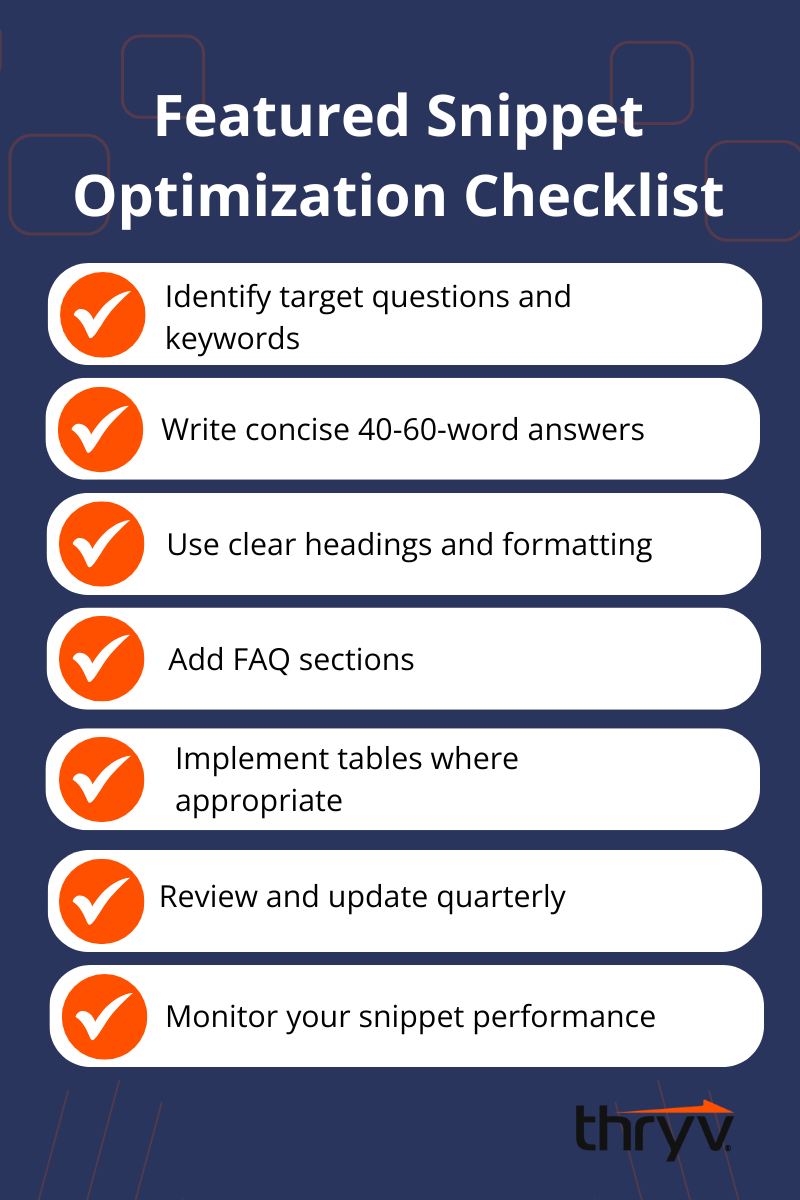
Start small. Choose one high-traffic page on your website and apply these five principles: write a direct answer to a common customer question, add clear headings and formatting, create a simple FAQ section, and commit to reviewing it quarterly. That single optimized page can earn you a featured snippet that drives qualified traffic for months or even years.
The businesses that win in AI-powered search aren’t necessarily the biggest or the oldest —t hey’re the ones that make it easy for search engines to find, extract, and trust their content. With the right approach and tools like Thryv to simplify the technical work, you can position your business as the go-to source in your market.
Your customers are asking questions. Make sure your website is ready with answers.

FAQ
Q: What’s the difference between featured snippets and regular search results?
A: Featured snippets appear in a highlighted box at the top of search results (position zero), above all other organic listings. They display a direct answer extracted from a webpage, along with the page title and URL. Regular search results show as standard blue links with meta descriptions below the snippet. Featured snippets capture significantly more attention and clicks because they’re visually prominent and provide immediate answers.
Q: Do I need to hire an SEO expert to optimize for featured snippets?
A: No. While SEO expertise helps, featured snippet optimization focuses on clear writing and proper formatting — skills most business owners already have. The key is answering customer questions directly, using headings and lists, and keeping the content up to date. Platforms like Thryv provide built-in guidance that makes technical optimization accessible without hiring specialists.
Q: How long does it take to see results from featured snippet optimization?
A: Most businesses see initial results within 4-8 weeks after optimizing content, though it can vary based on competition and your site’s existing authority. Pages that already rank on the first page of search results may earn snippets faster. Consistent optimization and regular content updates improve your chances over time, so think of this as an ongoing strategy rather than a one-time fix.