
A homeowner searches “AC repair near me” after their system stops working late at night. They open a few HVAC company websites on their phone. One loads slowly, has no recent reviews, and makes it hard to figure out how to contact someone. Another clearly shows services, reviews, and a phone number at the top of the page. That company gets the call.
If your website looks outdated, loads slowly, or makes people work to find information, it can quietly cost you jobs every week.
Most HVAC owners need a website that helps them get found, respond faster, and bring in more booked jobs without creating more manual work.
This guide breaks down what the best HVAC company websites do well, which website builders make the process easier, and how to build a website for HVAC contractors that supports more leads. You’ll also see how Thryv® helps HVAC businesses stay visible, respond faster, and turn more website visitors into booked jobs, without adding more work to your plate.
Key Takeaways
- Homeowners decide quickly who to call. A website that clearly shows service information, reviews, and contact options wins the call over one that makes visitors search for basic information.
- Slow, outdated websites can quietly cost HVAC businesses calls, especially during urgent repair situations when a homeowner is ready to book immediately.
- Dedicated service and location pages help your business appear in more local HVAC searches and connect homeowners to the exact service they need.
- HVAC websites perform better when reviews, business information, and customer follow-up stay active and current without requiring constant manual updates.
- The right website builder doesn’t just launch a site, it connects your website to your reviews, listings, and follow-up system so everything works together.
Table of Contents
- What Makes a Great HVAC Company Website?
- The Best HVAC Websites and What They Get Right
- The Best Website Builders for HVAC Contractors
- How to Build an HVAC Website Step by Step
- Why Your HVAC Website Needs to Be Connected to Your Whole Marketing System
- FAQs About HVAC Website Builders
- The Best HVAC Websites Don’t Just Look Good — They Work Hard
What Makes a Great HVAC Company Website?
Most HVAC websites don’t fail because of bad design. They fail because they’re missing essential information the moment a homeowner lands on the page.
Homeowners looking for HVAC help usually want answers quickly. Your website should make it easy to understand what services you offer, how to contact you, and whether your business feels trustworthy.
Start with the basics:
- A phone number and primary call to action should appear at the top of every page, especially on mobile devices.
- Services should be written in plain language, including AC repair, furnace installation, heat pump repair, and emergency services, with no technical jargon.
- Recent customer reviews should be visible on the homepage so homeowners can quickly see proof from past customers.
- Fast load times on mobile. Your website should work well on phones since many HVAC customers search and book service from mobile devices.
- A way to request service without calling. Customers should be able to request service, ask for a quote, or contact your business without extra steps.
Clear service pages and call-to-action buttons help homeowners book faster. Financing information, seasonal promotions, and after-hours service messaging also help customers decide whether to call your business or move on to another company.
Beyond the basics, visibility also affects whether your website consistently brings in leads. Local SEO (search engine optimization) helps your business appear in search engine results when homeowners search nearby, while AEO (answer engine optimization) helps your company appear in AI-generated recommendations. Many HVAC businesses improve both areas through broader HVAC marketing software that keeps websites, listings, reviews, and customer communication working together.
The Best HVAC Websites and What They Get Right
The best HVAC websites make it easy for homeowners to understand what the company does, where they work, and how to contact them quickly.
Looking at real examples is one of the fastest ways to see what helps turn searches into calls. As you review these sites, pay attention to how quickly you can find service information, reviews, contact details, and trust signals from your phone. A clear web design is what helps homeowners book services faster.
1. Del-Air Heating, Air Conditioning, Plumbing, and Electrical
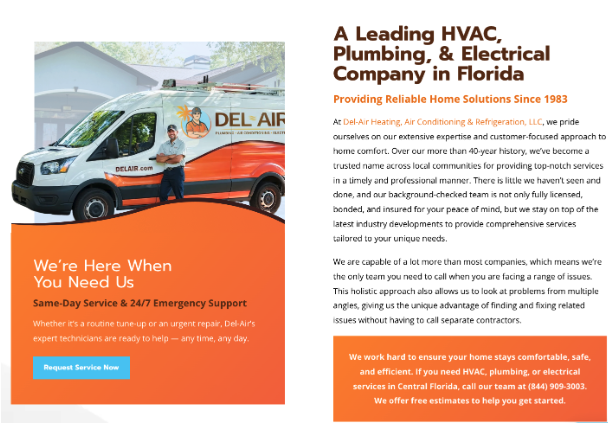
What this gets right: The Del-Air homepage immediately tells visitors what services the company offers and where they operate. A homeowner searching for emergency HVAC repairs can quickly find the phone number, financing information, and request-service options without scrolling through multiple pages.
This works because it reduces hesitation during urgent situations. The website also places customer reviews and call-to-action buttons near the top of the homepage, helping homeowners take the next step faster.
What to pay attention to:
- Emergency service messaging visible above the fold
- Contact options are easy to find on mobile
- Reviews are placed near primary calls-to-action
- Service pages are broken out clearly by repair type and system
2. Air Experts
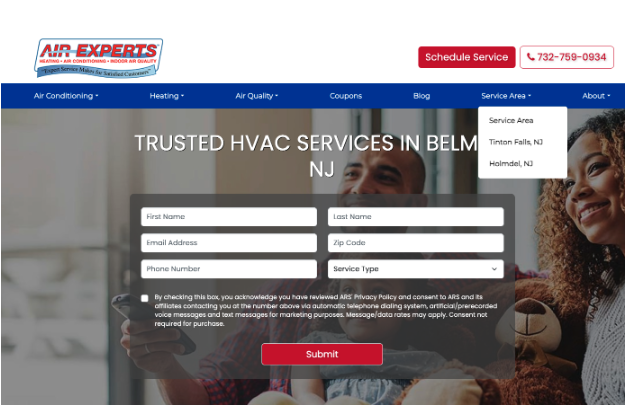
What this gets right: Air Experts uses location-specific service pages throughout the website. Someone searching for “furnace repair in New Jersey” lands on a page that confirms the service area, available services, and makes it easy to book.
This works because search engines rely heavily on clear service-area information to match businesses with nearby searches. It also creates a better user experience because homeowners can quickly confirm the company serves their area before submitting a contact form.
What to pay attention to:
- City and service keywords appear naturally throughout page copy
- Clear “Schedule Service” buttons on every page
- Separate pages for heating, cooling, and indoor air quality
- Mobile pages load quickly without clutter
3. Arctic Air Conditioning
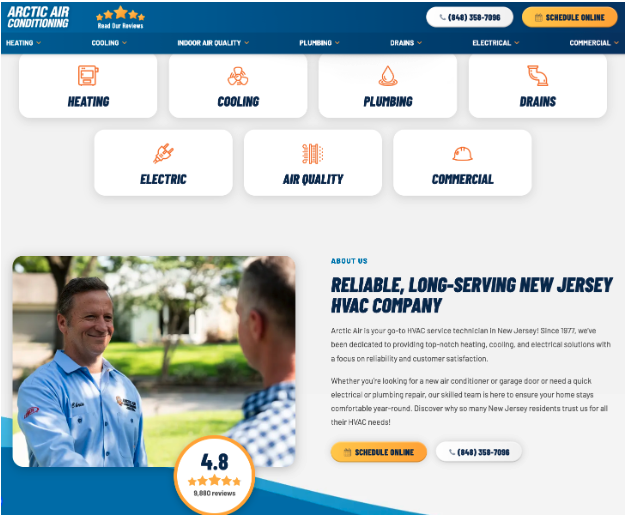
What this gets right: Arctic Air leads with speed and trust. The homepage quickly explains available HVAC services while showing awards, certifications, and customer reviews close to the top of the page.
This works because homeowners often decide within seconds whether a company feels credible enough to contact. Strong social proof combined with an easy contact experience helps reduce uncertainty and convert right away. The site also keeps forms short, which helps capture more leads from mobile visitors.
What to pay attention to:
- Reviews displayed near primary calls-to-action
- Short, mobile-friendly contact forms
- Financing and maintenance plan information clearly visible
4. Parker & Sons
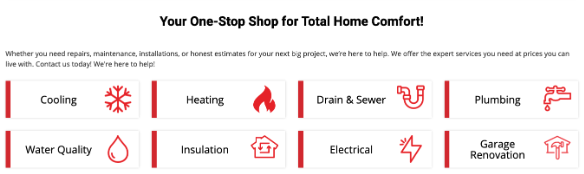
What this gets right: Parker & Sons makes it easy for homeowners to understand what services the company offers and how to take the next step quickly. The website clearly highlights scheduling options, financing information, and multiple contact paths across both desktop and mobile experiences.
This works because customers comparing HVAC companies want fast answers without digging through multiple pages. Clear phone numbers, visible booking options, and dedicated service pages help support a smoother customer experience.
The site also separates services into individual pages for AC repair, heating repair, maintenance, and installation. That helps improve visibility in search engines and gives homeowners a direct path to the exact service they’re searching for.
What to pay attention to:
- Dedicated pages for individual HVAC services
- Large mobile-friendly contact buttons
- Financing information displayed clearly
- Customer reviews placed near booking CTAs
The strongest HVAC company websites usually make the next step obvious. Customers can quickly see what services you offer, whether they trust your business, and know exactly how to contact you before they move on to another company.
The Best Website Builders for HVAC Contractors
Choosing a website builder usually comes down to one question: how quickly can you get a website live that helps bring in calls without creating more work later? Here are the most common options to stack up for HVAC businesses.
| Website Builder | Best For | Core Features | Use Case |
| Thryv | HVAC businesses focused on visibility and lead generation | AI Website Builder, reviews integration, Listings Management, quote forms, Social Media Management | Helps HVAC businesses keep service information, promotions, listings, and reviews current automatically |
| Wix | Smaller HVAC businesses launching a first website | Mobile templates, service pages, online forms, basic SEO | Useful for getting a basic local website live quickly |
| WordPress | Businesses investing heavily in local search visibility | Service-area pages, blog, SEO plugins | Build separate city pages and content for multiple cities |
| Housecall Pro | HVAC teams focused on scheduling workflows | Online booking, customer request forms, dispatch connection | Helps turn after-hours website requests into scheduled jobs |
1. Thryv
Thryv helps HVAC businesses launch websites faster without hiring a developer or manually building every page from scratch.
Best for: HVAC businesses focused on visibility and lead conversion
Key Features:
- AI-Powered Website Builder that creates HVAC service and location pages automatically
- Listings Management that keeps your business information accurate across directories
- Reputation Management with AI Review Response to keep reviews active after every completed job
- Social Media Management to keep your business visible between service calls
- Online quote requests and contact forms
HVAC Use Case: Before the summer rush, an HVAC company updates financing offers, seasonal tune-up promotions, and after-hours service messaging before summer demand spikes. Thryv’s AI-Powered Website Builder can automatically create mobile-ready repair and installation pages, while Listings Management updates holiday hours and service-area details across directories and search results. And because everything lives in one unified platform, nothing falls through the cracks when things get busy.
2. Wix
Wix is often a good fit for smaller HVAC companies that need a website to go live quickly without hiring outside help.
Best for: Smaller HVAC businesses launching a first website
Key Features:
- Responsive design templates
- Service pages and landing pages
- Contact and quote forms
- Basic SEO setup
HVAC Use Case: A smaller HVAC company creates separate pages for AC installation and furnace repair so homeowners searching for specific services can find the right page faster.
3. WordPress
Businesses focused on long-term search visibility often choose WordPress because it gives them more flexibility over content and service-area pages. With the right plugins and a developer, it supports extensive service-area pages, blog content, and technical SEO.
Best for: Businesses investing heavily in local search visibility
Key Features:
- Flexible website design
- Service-area page expansion
- Blog and email marketing integration
- SEO plugins and local search support
HVAC Use Case: An HVAC company builds separate pages for every city they serve, helping them appear in more local search engine results for repair and installation services.
4. Housecall Pro
Housecall Pro is commonly used by HVAC businesses already managing scheduling and dispatch through the platform.
Best for: HVAC teams focused on scheduling and dispatch workflows
Key Features:
- Online booking requests
- Mobile-friendly website pages
- Customer request forms
- Scheduling integration
HVAC Use Case: A homeowner submits an after-hours AC repair request online instead of waiting until morning to call, helping the business capture a lead that might otherwise go elsewhere.
See What an AI-Built HVAC Website Actually Looks Like
Thryv’s AI-Powered Website Builder creates a professional, mobile-optimized HVAC site automatically — and connects it to your reviews, listings, and social media from day one.
How to Build an HVAC Website Step by Step
Every step below is written with HVAC businesses in mind, the services offered, the customers to reach, and the seasonal challenges to deal with.
1. Choose a Website Builder Suitable for HVAC
Choose a builder that supports service pages, quote requests, reviews, and responsive website design without requiring a developer or constant updates. Thryv’s AI-Powered Website Builder can create mobile-ready repair, installation, and maintenance pages faster so HVAC businesses can get online without spending weeks building pages manually.
2. Set Up Your Service and Location Pages First
Start with the pages customers already search for, including AC repair, furnace repair, HVAC installation, maintenance, and emergency services.
If you serve multiple cities, create separate pages for each service area. A homeowner searching “emergency furnace repair in Plano” is more likely to land on a city-specific service page than a general homepage.
Need help thinking through your content strategy? This guide to marketing your small HVAC business covers how service-based businesses attract more local leads.
3. Add Your Real Content: Reviews and Photos
Use recent reviews, completed job photos, and short service explanations throughout your website. Customers comparing HVAC companies often want proof that your business handles the type of work they need. Fresh reviews and project photos help turn more website visitors into calls.
After completing an AC replacement, a homeowner might receive a review request later that day, followed by a seasonal maintenance reminder a few months later. Thryv’s AI Review Response and AI Automation Assistant help keep those customer touchpoints moving without requiring manual follow-up every time.
4. Optimize for Local Search and AI Search
Local SEO helps homeowners find your business on Google, while AI search helps your company appear in AI-generated recommendations.
Listings Management helps HVAC businesses update holiday hours, after-hours service availability, and seasonal promotions across directories without editing each listing one by one. Thryv’s AEO/SEO Solutions go further, making sure your business is structured to appear in both traditional search and AI engines.
5. Connect Your Website to Your Follow-Up System
A website lead can disappear quickly if nobody responds. A customer submitting a quote request after hours may schedule service with another HVAC company by the next morning.
Set up forms, follow-up messages, and reminders so every inquiry has a next step. AI Lead Insights can flag repeat customers, high-intent emergency-service requests, or homeowners who responded multiple times to financing offers. AI Automation Assistant can then send tune-up reminders, financing follow-ups, or missed-estimate check-ins automatically after a customer reaches out.Learn how these tools work together in a small business software for HVAC businesses.
Why Your HVAC Website Needs to Be Connected to Your Whole Marketing System
An HVAC website can still lose jobs if reviews, listings, and follow-up aren’t kept updated.
When your website, reviews, and business listings aren’t connected, each piece has to be maintained separately. Those gaps often lead customers to another HVAC company.
Connected tools help reduce those missed opportunities:
- AI-Powered Website Builder helps HVAC businesses create repair, installation, and maintenance pages faster without building every page manually.
- AI Review Response drafts personalized replies to incoming reviews after completed jobs.
- CaptionAI and AI Content Assistant can turn completed repairs or installations into ready-to-post social content that keeps your business visible between service calls and supports broader HVAC social media marketing efforts.
- Listings Management helps update holiday hours, after-hours service availability, financing promotions, and service-area changes across directories.
- AI Automation Assistant can send maintenance reminders, financing follow-ups, missed-estimate check-ins, and review requests automatically after completed jobs.
- AI Lead Insights helps prioritize repeat customers and high-intent emergency-service leads.
- Reputation Management keeps your review volume and ratings healthy over time, which directly affects how often you appear in local search results.
All of these tools live in one unified platform, which means your website, listings, reviews, and follow-up stay aligned without you having to log into separate systems.
What One HVAC Business Did Differently
Before working with Thryv, Ely Heating & Cooling managed reviews, visibility, and customer communication separately. As the business grew, maintaining each piece on its own became harder to sustain.
After connecting their website, review collection, and lead follow-up through Thryv, the company saw a 30–50% higher close rate. Their website, reviews, and communication started working together more consistently, helping turn more inquiries into booked jobs.
If you’re curious how the platform works in a real HVAC context, the full case study walks through exactly what changed and what results followed.
See What a Connected HVAC Website Looks Like in Practice
See how a real HVAC company used Thryv’s connected platform to build visibility, collect more reviews, and grow their service call volume starting with the website.
FAQs About HVAC Website Builders
What is the best website builder for HVAC?
The best HVAC website builder helps customers find you quickly, contact you easily, and schedule service without confusion. Look for tools that support mobile-friendly pages, service-area pages, customer reviews, and online quote requests.
How do I make a website for my HVAC business?
Start with your core services, service areas, phone number, reviews, financing information, and contact forms. Many HVAC businesses use website builders designed for small businesses so they can launch service pages and scheduling tools without hiring a developer.
How do I get my HVAC website to show up on Google?
Your website should include service-specific pages, city pages, accurate business information, and recent customer reviews. Consistent listings, easy-to-use pages, and strong local SEO all help improve visibility in search engine results.
What pages should an HVAC website have?
Most HVAC websites should include pages for AC repair, furnace repair, installation, maintenance, emergency services, financing, reviews, and contact information. Businesses serving multiple cities should also create separate pages for each service area.
How often should I update my HVAC website?
Update your website anytime your service areas, hours, financing offers, emergency services, pricing, or payment processing options change. Adding fresh reviews, completed project photos, and seasonal promotions throughout the year also helps keep your website active.
Can my HVAC website help me rank higher on Google Maps?
Yes. Consistent business information, local service pages, customer reviews, and local SEO all support better Google Maps visibility. Fast-loading pages and clear contact information also help homeowners stay on your website once they find your business.
The Best HVAC Websites Don’t Just Look Good — They Work Hard
The HVAC businesses growing consistently are using websites that help homeowners find the right service, request help quickly, and book with confidence.
The challenge is keeping service pages, reviews, promotions, and follow-up active and accurate during busy seasons or after-hours service periods.
Thryv helps HVAC businesses build AI-powered websites faster, create repair and installation pages automatically, collect more reviews after completed jobs, update business information across listings, and automate customer follow-up so more website visitors turn into booked service calls.
If your website should be doing more to win you jobs, the next step is straightforward.
Your HVAC Website Should Be Winning You Jobs While You’re on the Job
Thryv builds a professional, AI-powered HVAC website and connects it to your reviews, listings, and social media — automatically. See how it works with a free trial.